Yes, you read that right. A customer travelled from Barking to Homerton via West Ham and Stratford. At West Ham they followed the instructions on a sign and touched their card on a validator in the subway. When they got to Homerton a revenue inspector checked their card and saw the touch out at West Ham, so they were issued with a penalty fare and prevented from touching out. Thankfully I saw their post on Railforums and I am assisting them in appealing the penalty fare.
What Happened
West Ham is one of a number of stations where validators are provided within the gated area of a station to enable customers to touch in or out when the rest of their journey is covered by a traditional ticket. In case a customer touches one of the validators in the middle of a PAYG journey they are set to what is known as continuation exit. This means that although a journey will be ended at that station, the card is still validated and the journey can be continued. You can read more about this on Same Station and Continuation Exits.
When the Revenue Inspector read the card at Homerton they misunderstood the special nature of West Ham and mistakenly thought that the card was not validated. It’s a pity they didn’t let the customer touch out because that would have opened the gate and charged the correct fare.
Why Does This Go Wrong
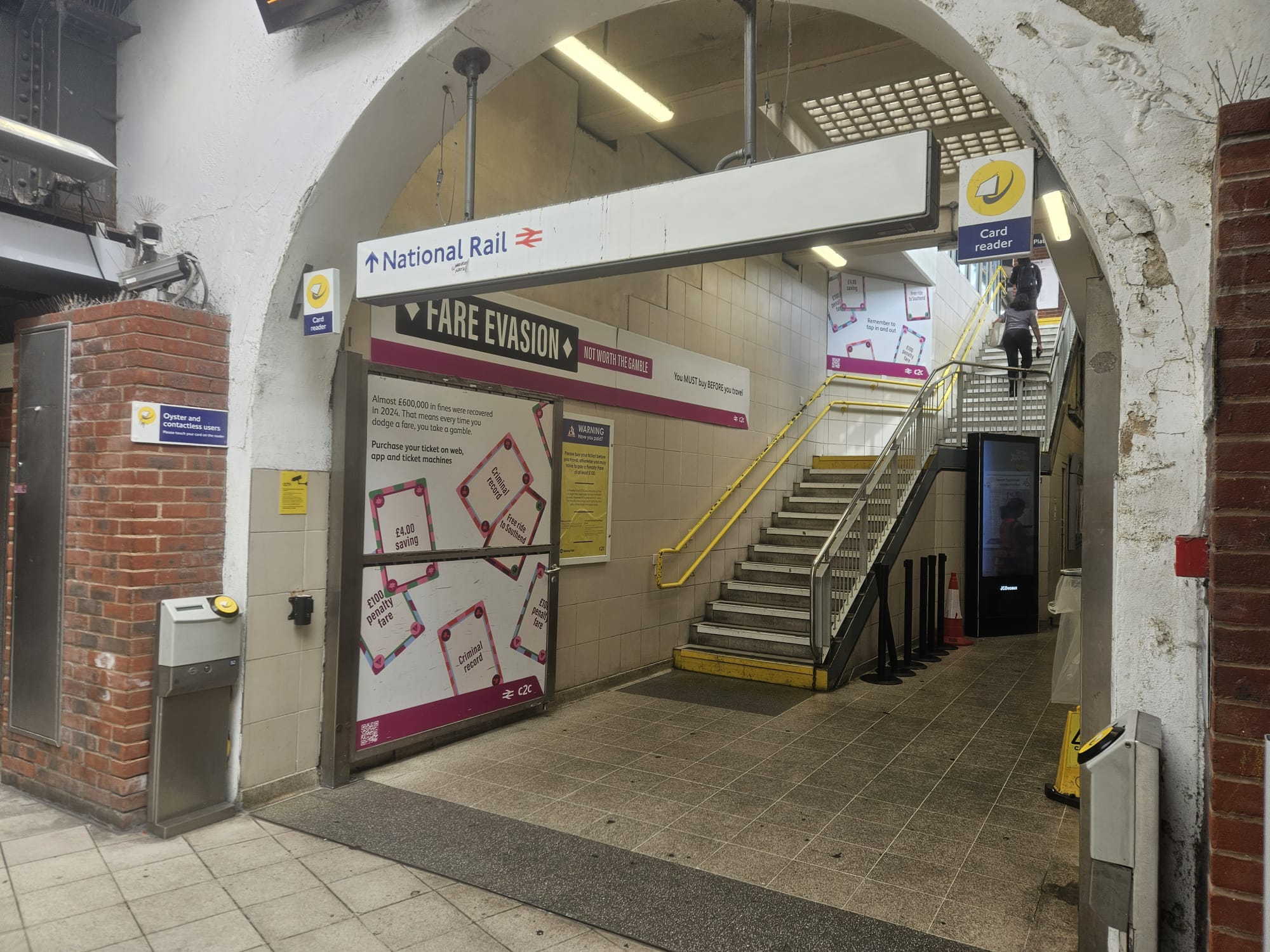 In a word, signage. I have been asking for the signage at these validators to be made clearer, so that customers don’t touch them unnecessarily, since shortly after creating this site. In the very early days a visitor here complained about getting a penalty fare on the DLR even though the system always charged the correct fare. Their “crime” was to touch the then yellow reader at Ealing Broadway when changing from a GWR local service to the Central line, and then onto the DLR at Bank. Another hotspot is Kentish Town, while Farringdon became more of an issue when the Elizabeth line opened.
The picture shows the validators at West Ham with the stairs leading up to the c2c platforms. You’ll notice that one of them is right next to a huge poster about fare evasion. The sign above the validator simply says “Oyster and contactless users: Please touch your card on the reader”. Is it any wonder that customers get confused?
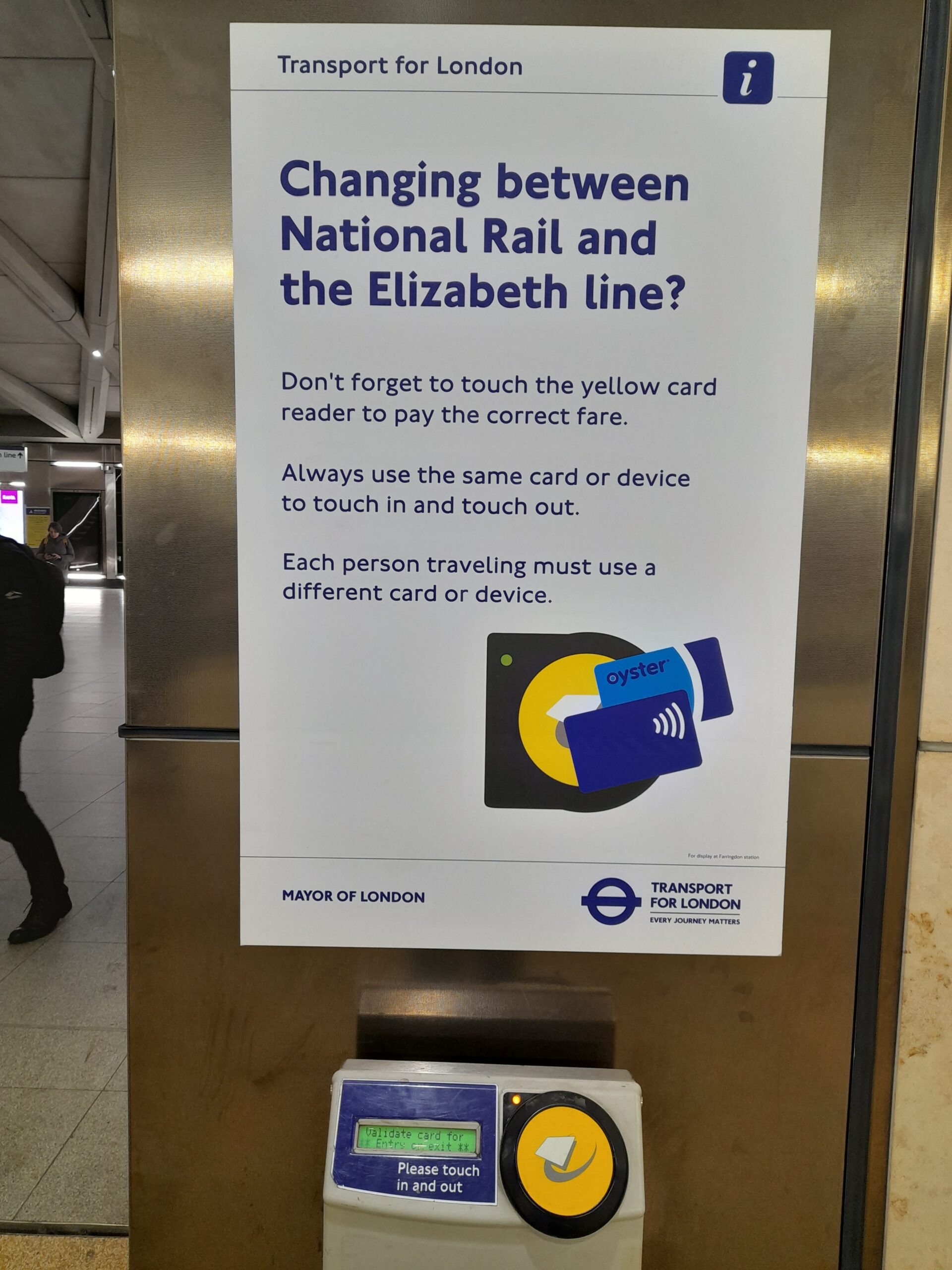
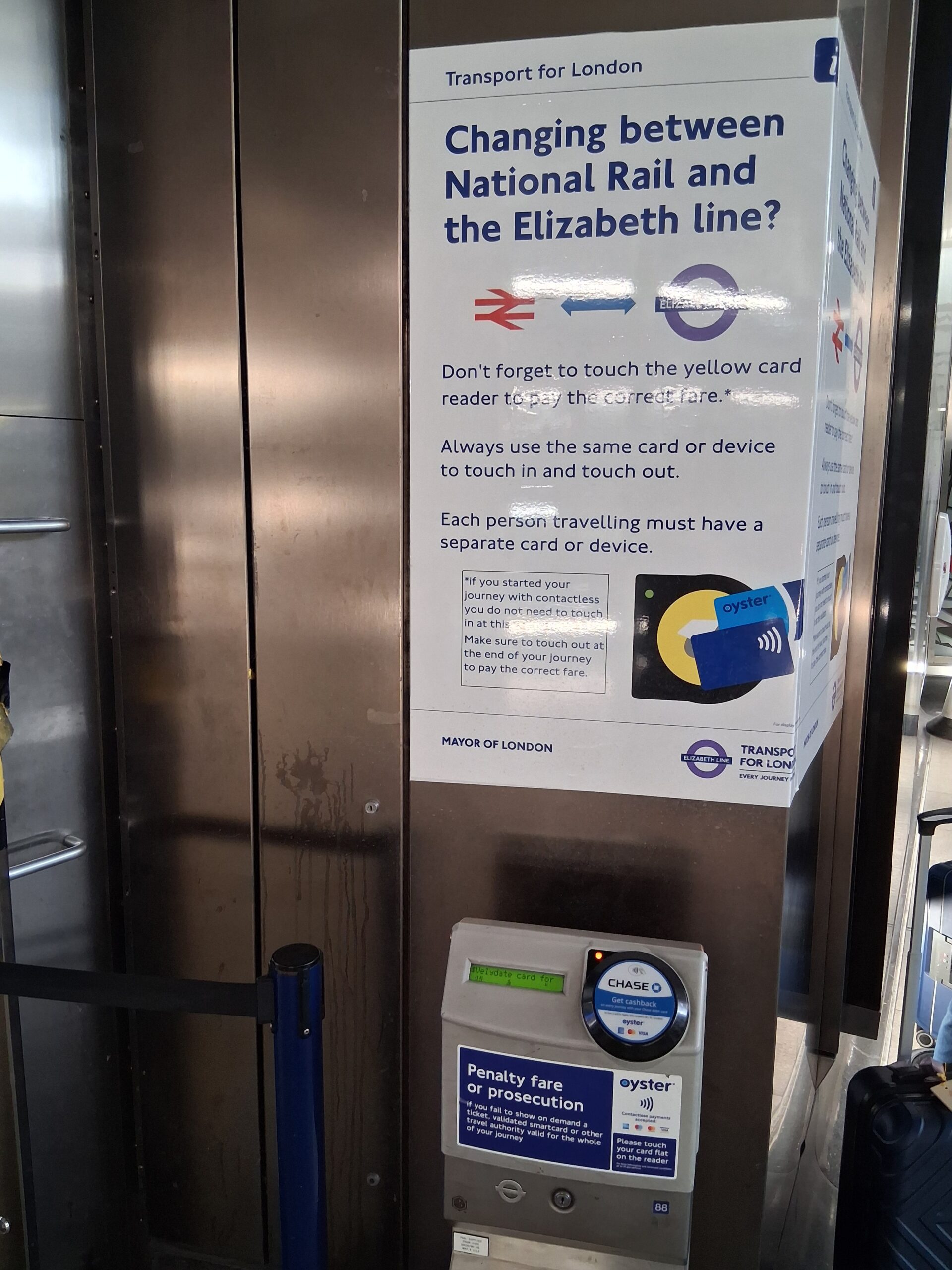 TfL have improved signage at some locations. The picture on the left (or top) shows the poster at Farringdon when the Elizabeth line had just opened. On the right (or bottom) is the current version with text added explaining that if you started your journey on contactless you don’t need to touch in here. It could be improved by (a) adding the word Oyster, and (b) expanding it to say that if both parts of the journey are on Oyster/contactless there is no need to touch in or out here. You can click on any image on this page to see a larger version. [Apologies for the glare on the current picture – they seem to have used very shiny paper this time.]
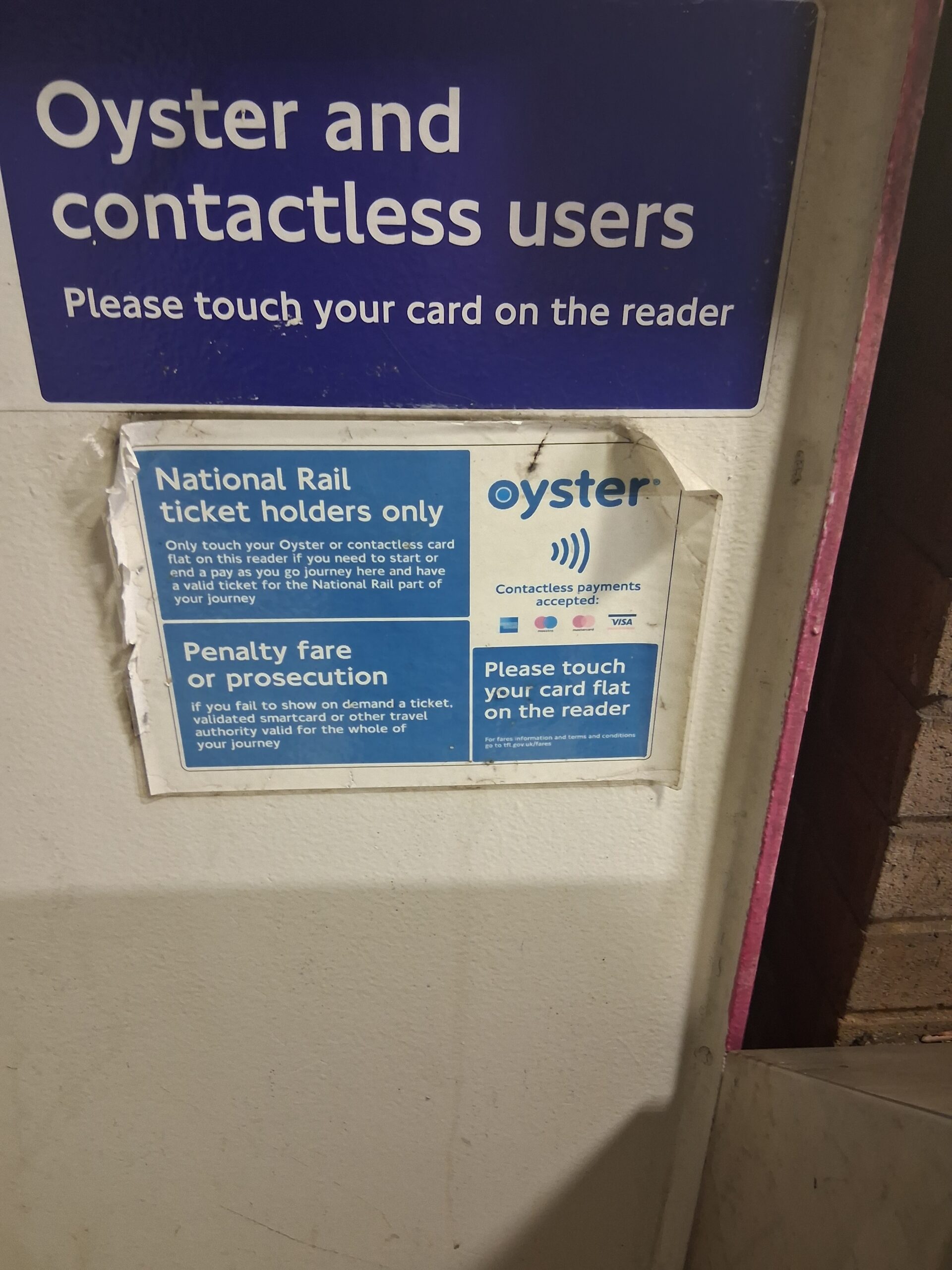 At another hotspot station, Kentish Town, there is a different solution. The lower label clearly states that the validator is only for use by National Rail ticket holders. The upper dark blue label could do with being removed here because that suggests that the reader is for all Oyster and contactless users, contradicting the correct label below. They also need to put the proper label on the validator on the opposite side of the walkway between the National Rail footbridge and the Underground entrance hall.
In fact, that sign probably ought to replace other signs at any of the stations with validators within the paid area. It would save a lot of unnecessary touching, and lessen the chance that a revenue inspector gets it wrong further down the line. How about it, TfL?
What do the Train Companies say
I reached out to both c2c and TfL about this issue. A c2c spokesperson said:
While the customer began their journey on the c2c network, the Oyster/contactless ticketing system at West Ham is managed by TfL and the penalty fare was issued by London Overground. Decisions relating to ticket checks, penalty fares and any subsequent appeals are therefore matters for the operator that issued the penalty fare and TfL as the ticketing system provider.
And a TfL spokesperson added:
In order to review the specific circumstances of the incident, customers are entitled to submit an appeal and provide full details of their journey, together with any mitigating circumstances they wish to be considered. Information on how to appeal can be found on the our website at: Penalty fares and how to pay them – Transport for London.
To be honest, both these responses miss the point that there is a fixable flaw in the system. The customer has already appealed once, and been rejected, so is having to appeal a second time. I can only hope that this issue is taken up during regular meetings between the Rail Delivery Group and TfL. Confidence in the PAYG system will be eroded if more people suffer issues. While those using contactless cards are unlikely to get a penalty fare, there is still no need for them to be touching random validators in the middle of their journey, and not doing so may make it easier for those who do have to touch to avoid a queue.
In my opinion it is inequitable that Oyster and Contactless are subject to completely different degrees of revenue control. Either access to live data is essential for revenue operations, in which case TfL should not be running Contactless in its current form, or it is unnecessary in which case they should not expose that information on Oyster. If the demographics of Oyster and Contactless users are different, which I suspect they are as a cash product and the only way of adding things like senior/disability railcards, then there may additionally be equalities implications to this disparity.